
How to Choose LED Filament Bulb Base Types and Cap Sizes for OEM Projects
A practical OEM sourcing guide to selecting the right LED filament bulb base types and cap sizes, reducing mismatch risk between socket, specification, and packaging.
← BACK TO JOURNALOEM sourcing guide
01Choose the right base type before the sample stage becomes expensive
For LED filament bulb projects, the base or cap is not a small detail. It determines fixture compatibility, installation fit, market acceptance, and whether your specification sheet reads clearly enough for production teams and distributors to use without back-and-forth.
- Reduce mismatch risk between bulb, socket, and target market.
- Keep drawings, samples, and purchase specs aligned from the start.
- Avoid delays caused by cap-size confusion during quoting and approval.
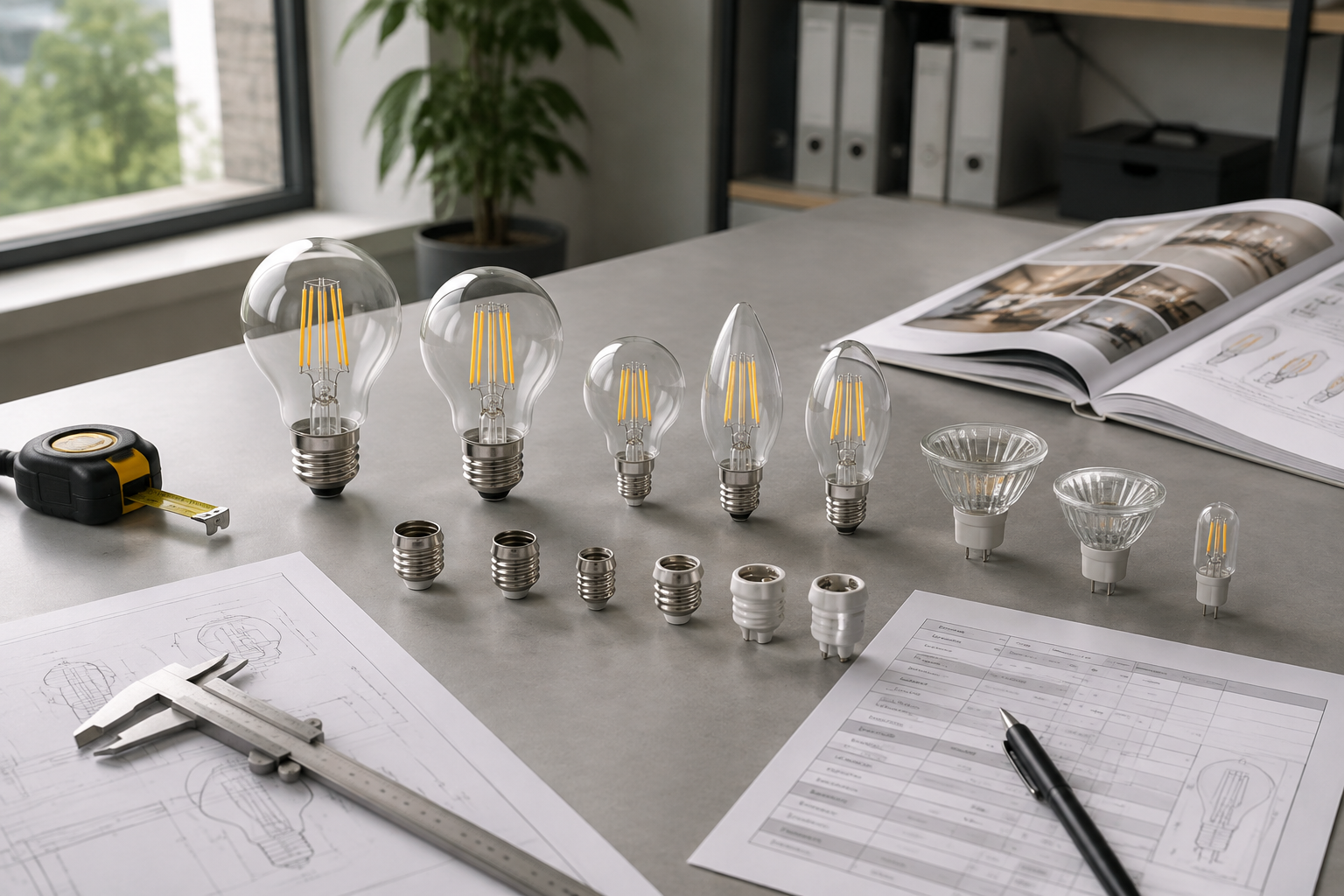
Core terminology
02Understand the naming logic before you compare options
In OEM sourcing, base type, cap size, and code naming are not interchangeable. The base type tells you how the bulb connects, the cap size defines the physical standard, and the code is the shorthand that keeps drawings, samples, and purchase orders aligned.
When a request says “E14 filament bulb”, it usually combines the cap family and the threaded base standard. A complete specification should make that logic visible, so engineering, packaging, and procurement all read the same requirement.
For filament projects, this naming clarity matters because small differences can affect socket fit, market compatibility, and the number of sample revisions needed before approval.
Naming logic
Defines how the lamp interfaces with the holder or socket.
Describes the dimension family buyers and factories use to match compatibility.
Helps drawings, quotations, and PO lines stay consistent.
Reduces the chance of ordering a lamp that fits the wrong socket family.
Selection workflow
For OEM projects, the fastest way to reduce sourcing errors is to move in one direction: fixture compatibility first, then market standard, then electrical and mechanical constraints, and only then packaging language.
Base type and cap size should be locked before artwork, carton copy, and compliance language are finalized.
Start with the fixture interface
Confirm what the lamp holder accepts in the real fixture, not just what appears on a catalog sheet. Check the socket shape, insertion depth, and whether the bulb must sit flush, project outward, or clear a shade, cage, or diffuser.
Match the market standard
Different regions and channels often expect different cap families. Align the base designation with the target market early so your OEM brief, distributor listing, and packing artwork all speak the same language.
Check electrical and mechanical limits
Verify that the chosen base leaves enough room for the driver, filament layout, and internal structure, while still fitting the fixture geometry. If space is tight, the bulb body and cap combination should be reviewed together rather than separately.
Lock the labeling language last
Once the physical fit is confirmed, write the product name, cap code, and packaging notes consistently across sample requests, spec sheets, and order confirmations. Clear naming prevents avoidable back-and-forth between sourcing and production teams.
Fixture check
Measure the lamp holder and confirm how the bulb must seat inside the fixture.
Region check
Use the cap family expected by the destination market or channel.
Space check
Review internal room for the filament structure and driver before release.
Label check
Keep the code, carton copy, and purchase order wording identical.
Next step
If your team is building an OEM spec pack, document the fixture photo, target market, and cap designation together before asking for samples. That single page is often enough to prevent the most common mismatch.
Request an OEM quoteCommon mistakes and verification checklist
03Avoid the spec mismatches that slow OEM sampling and ordering
When buyers mix up base type, cap size, or regional naming, the result is usually a sample that fits the wrong socket, a label that confuses the market team, or a carton that needs to be reworked. The safest path is to verify the interface first, then confirm the code format, and only then lock the artwork.
Critical check
Do not approve a filament bulb spec sheet until the base code matches the target fixture, the cap size matches the market standard, and the naming is written the same way across sample request, PO, and packaging.
Common errors
The issues below show up most often during OEM sourcing.
Error 01
Matching by appearance instead of interface code
Two bulbs can look similar and still use different caps. Always confirm the actual base designation before comparing samples.
Error 02
Assuming one market name means one standard
Regional shorthand can hide variants. Keep the full code visible in every quote so the team does not translate it differently later.
Error 03
Locking artwork before the spec is final
If the label is printed too early, a minor code correction can trigger packaging waste and delay the first order.
Buyer checklist
Use these yes/no prompts before you move to sampling or approval.
Verify the socket or holder first so the bulb base is chosen for the actual fitting.
Use the exact code, not just a nickname or a shape description.
Check that sales, sourcing, and packaging all use the same terminology.
Any mismatch at this stage usually becomes a delay later in the project.
04Quick Technical Answers
These answers explain how to choose the right LED filament bulb base and cap specification for OEM sourcing.
What should I confirm first when selecting an LED filament bulb base type?
Confirm the fixture interface first. The article says the lamp holder, socket shape, insertion depth, and seating requirement should be checked before looking at packaging or label wording, because the base choice must match the actual fixture fit.
How are base type, cap size, and code name different?
Base type describes how the bulb connects to the socket, cap size refers to the standardized physical fit, and the code name is the short label used to keep drawings, quotations, and purchase orders consistent. The article warns these terms are not interchangeable.
Why does cap selection matter in OEM projects?
Cap selection matters because it affects fixture compatibility, installation fit, market acceptance, and whether the specification is clear enough for production and distribution teams. A wrong cap can create sample revisions, quoting delays, and packaging rework.
What is the safest workflow for choosing a filament bulb cap?
The safest workflow is fixture compatibility first, then target market standard, then electrical and mechanical constraints, and finally labeling language. The article emphasizes locking the base type and cap size before artwork, carton copy, and compliance text are finalized.
What should I include in an OEM inquiry for filament bulb samples?
Include the base type and cap code, the target market or regional standard, fixture opening and clearance limits, any labeling or packaging requirements, and the sample quantity or timeline. If the code is uncertain, the article recommends sending a bulb photo, fixture photo, or simple drawing.
OEM inquiry checklist
05Prepare the last details before you ask for samples
A clean brief names the base type, cap size, target market standard, and the fixture limits that affect fit. If the lamp must match a specific look, include a photo or sketch so the review starts with the right reference.
Before you send the inquiry, confirm:
- The base type and cap size code you want to test
- The target market or regional standard
- Fixture opening, clearance, and lamp envelope limits
- Any labeling, packaging, or language requirements
- The sample quantity and your expected project timeline
If you are unsure about the code, send the bulb photo, fixture photo, or a simple drawing and note where the lamp will be used.
Contact: info@aromalightco.com


Looking for a Product, Not Just Information?
Explore AromaLight LED filament bulb models or send us your specifications, reference photos and OEM / ODM requirements.