
Continuous Aging for LED Filament Bulb Quality Control
Learn why continuous aging is a critical pre-shipment quality-control gate for LED filament bulbs, what instability it can reveal, and how buyers can turn test observations into a batch release decision.
← BACK TO JOURNAL01Why continuous aging belongs before shipment
Pre-shipment quality control
A bulb that illuminates on command has cleared the startup check, but that is only the first indication that assembly and electrical contact are working. Continuous aging gives the factory a chance to watch the complete lamp operate over time, when driver behavior, light output, filament condition, and connections can reveal early instability.
Confirms that the bulb starts, produces light, and shows no immediate visible irregularity. Useful as an initial inspection, but too brief to show how the lamp behaves after it has been running.
Observes operating stability over a sustained run. It can make abnormal flicker, brightness changes, intermittent operation, electrical failure, poor connections, or driver instability easier to identify before batch release.
What the second gate is really checking
- Stable electrical operation after startup
- Consistent light output during continued running
- Driver and filament behavior as operation continues
- Connections that remain reliable rather than intermittent
02Aging turns a first glow into a quality observation
A quick power-on check confirms that a bulb starts and produces light. It does not show how the assembled lamp behaves after heat and operating time enter the picture.
During continuous aging, the factory can observe electrical stability, light-output stability, driver performance, filament condition, and connection quality. Abnormal flicker, unstable brightness, intermittent operation, electrical failure, poor connections, or other early issues may become easier to identify before shipment.
Aging is a pre-shipment screen for operating stability and early failures. It is not simply leaving lamps switched on, and it is not a guarantee of unlimited lifetime.
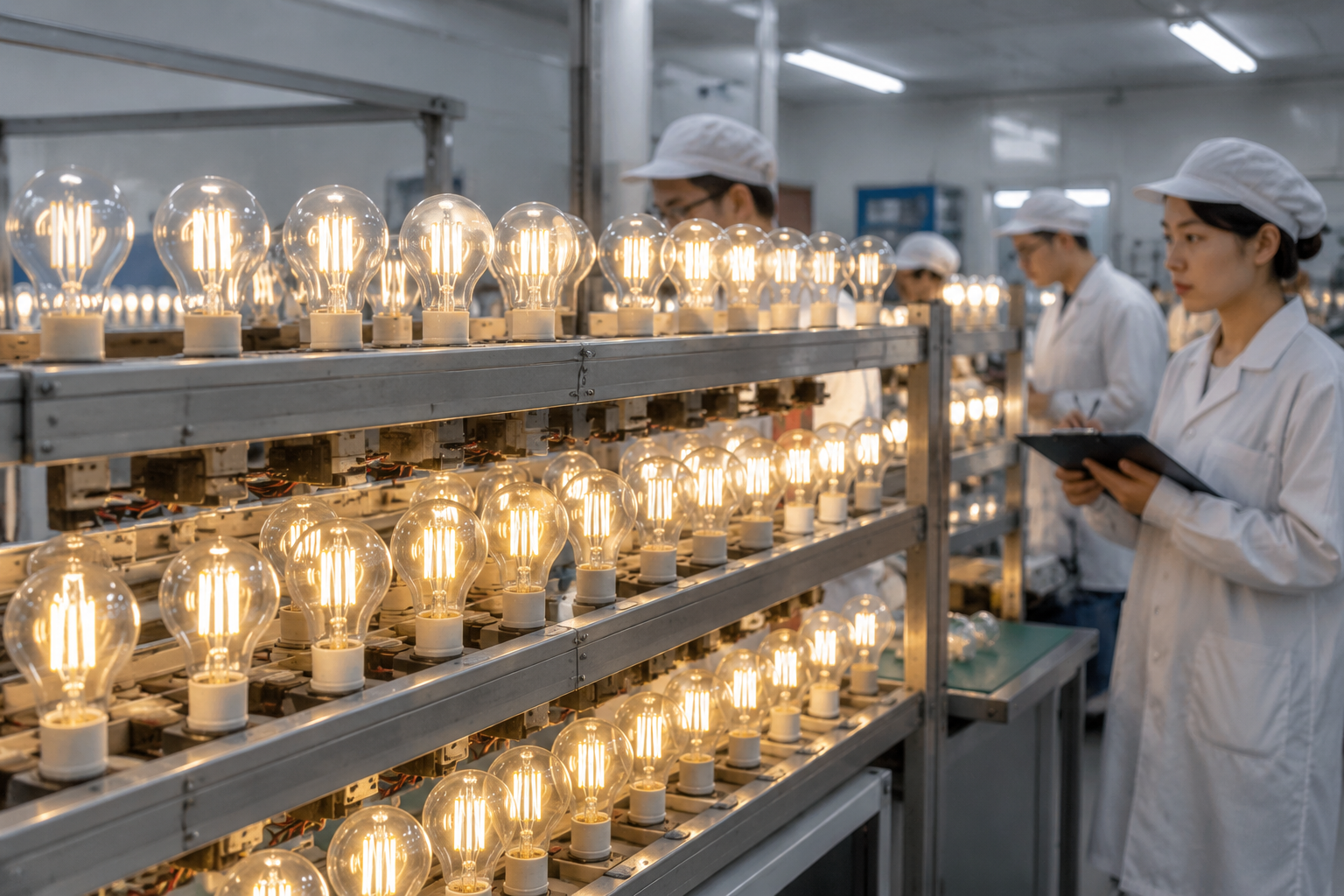
Four steps from power-on to disposition
Use the same controlled conditions and record what the batch does—not only whether one lamp lights.
-
01 · START
Power on
Confirm startup, basic illumination, and any immediate irregularity against the approved reference.
-
02 · RUN
Run continuously
Keep the assembled bulbs operating so heat, driver behavior, connections, and filament condition can be observed over time.
-
03 · OBSERVE
Observe the evidence
Look for brightness drift, abnormal flicker, interruptions, electrical faults, poor connections, and other early instability.
-
04 · DECIDE
Disposition the batch
Record exceptions and decide whether units are held, reviewed, corrected, or released before shipment.
Release principle A successful first glow is only the first gate; continuous evidence makes the batch decision more informed.
03The signals continuous aging can expose
A bulb that lights once has passed only the first inspection. Continuous operation gives the QC team a better opportunity to observe stability before a production batch is released.
| Quality signal | What aging may reveal | Why an instant check can miss it | Evidence to retain |
|---|---|---|---|
| Abnormal flicker | Flicker that becomes clearer as the bulb operates continuously or warms. | A brief power-on view may capture only a normal start-up moment. | Sample identity, operating setup, observation notes, and any agreed flicker assessment. |
| Unstable brightness | Brightness drift or an inconsistent light output during sustained operation. | Output can appear acceptable before the driver and lamp have operated continuously. | Comparison observations from startup and continuous running, linked to the batch reference. |
| Intermittent operation | Cut-outs, restarts, or irregular operation that repeat after the bulb has warmed. | The lamp may happen to be operating normally during a single switch-on check. | Timing of interruptions, repeated test results, fixture conditions, and sample disposition. |
| Electrical failure | An early electrical fault or a unit that stops operating during the screen. | Startup confirms illumination, but not continued electrical stability. | Test conditions, affected sample or batch, failure observation, and hold or release decision. |
| Poor connection | Intermittent behavior linked to a weak internal or assembly connection. | A connection can make contact initially and become unstable during operation. | Symptom record, sample reference, controlled setup, and supplier review outcome. |
| Driver instability | Changes in light output, interruptions, or other driver-related behavior over time. | A short test does not show how the driver behaves as operating conditions develop. | Driver or revision reference, monitored observations, test setup, and batch disposition. |
| Filament condition | Visible changes or irregular behavior in the filament assembly during operation. | The assembly may look normal before continuous operation exposes an early issue. | Visual observations, sample identity, operating context, and exception record if applicable. |
Aging or burn-in testing is a screening step for operating stability and potential early failures. It strengthens the pre-shipment review, but it is not a guarantee of unlimited service life.
04What continuous aging reveals inside the bulb
A bulb can light normally during an instant power-on check and still show instability after heat and operating time build. Continuous aging creates a longer observation window for the driver, light output, filament condition, and electrical connections.
Heat, driver behavior, and light stability are connected
During operation, heat begins around the working filament area. In applicable bulb structures, inert gas inside the glass envelope can help transfer that heat toward the glass wall. The glass then releases heat through its surface into the surrounding room. It is one part of the thermal path, not a standalone cooling guarantee.
That path should be considered alongside driver behavior and the intended fixture. As the bulb runs continuously, a quality team can observe whether brightness remains consistent, whether the driver stays electrically stable, and whether connections or filament assemblies develop an early problem.
Separate normal flicker from abnormal instability
Standard LED filament bulbs may have a certain level of flicker as a normal characteristic of their driver and electrical design. Flicker alone does not automatically mean the bulb is defective. A flicker-free version uses a driver solution designed for more stable output and significantly reduced visible or measurable flicker.
For buyers, the useful distinction is whether the observed behavior matches the selected light-stability requirement and remains consistent in the intended fixture. Abnormal brightness changes, interruptions, electrical failure, or poor connections call for investigation rather than a label based on one brief test.
This is a mechanism diagram, not a product cutaway. The complete heat path depends on the bulb structure and installation environment.
Before batch release: review the aging observations, compare like-for-like samples in the intended fixture, and record the agreed light-stability requirement. Aging is a screen for operating stability and early failures—not a guarantee of unlimited lifetime.
Discuss sample testing →05Quick Technical Answers
These answers explain how continuous aging supports LED filament bulb stability screening and pre-shipment batch decisions.
How does continuous aging differ from an instant power-on check?
Continuous aging provides a sustained operating window, while an instant power-on check confirms only startup and basic illumination. During continued operation, the factory can observe driver behavior, light-output stability, filament condition, connections, flicker, interruptions, and early electrical faults that may not appear during a brief switch-on inspection.
Which LED filament bulb problems can continuous aging expose?
Continuous aging can make abnormal flicker, unstable brightness, intermittent operation, electrical failure, poor connections, driver instability, and visible filament issues easier to identify. These observations help quality teams screen production units for early operating problems before shipment, although the test does not guarantee unlimited service life.
What evidence should a factory retain after an aging test?
A useful aging record should identify the sample or batch, operating setup, observation conditions, recorded symptoms, comparison reference where applicable, exceptions, and final disposition. The release decision should show whether the units were approved, held, reviewed, or corrected, with the evidence retained alongside the order record.
Does visible flicker always mean the bulb has failed quality control?
Flicker does not automatically indicate a defective LED filament bulb. Standard versions may show some flicker as a normal characteristic of their driver and electrical design, while flicker-free versions use a driver solution intended to provide more stable output. Investigate flicker when it is abnormal, changes with operation, or accompanies brightness drift, interruptions, or electrical failure.
Why is thermal behavior relevant during continuous aging?
Continuous operation also provides a longer window for observing thermal and electrical behavior together. In applicable bulb structures, inert gas can help transfer heat from the working filament area toward the glass envelope, where heat moves outward through the surface. The complete result still depends on the bulb structure, driver behavior, fixture, and surrounding conditions.
06Turn the aging record into a release decision
Buyer action sequence
One controlled review before the batch moves
Continuous aging is a stability screen, not a promise of unlimited life. Use it to compare the approved reference with production units and make early problems visible before shipment.
-
Confirm the sample identity and setup Record the sample or revision reference, holder, supply, control equipment, fixture context, and observation conditions.
-
Request aging observations Ask what happened during continuous operation: light-output stability, flicker behavior, driver performance, filament condition, connections, and interruptions.
-
Compare production units under the same conditions Run the approved reference and production samples side by side where possible. A quick power-on result should remain only the first check.
-
Choose the batch disposition Approve when the recorded behavior matches the agreed reference; hold or review when repeatable instability or an unexplained change appears.
Release principle: keep the evidence with the batch record. Aging can help expose early failures before delivery, but it does not replace a defined quality review or establish unlimited service life.



Looking for a Product, Not Just Information?
Explore AromaLight LED filament bulb models or send us your specifications, reference photos and OEM / ODM requirements.