
How to Evaluate LED Filament Bulb Warranty Terms Before a Wholesale Order
A practical guide to reviewing LED filament bulb warranty terms against order quantity, destination market, voltage stability, product configuration, fixture conditions, and after-sales responsibilities.
← BACK TO JOURNALWHOLESALE RISK REVIEW
A warranty only makes sense in the context of the order.
For a bulk LED filament bulb purchase, the warranty is not simply a number to place beside a competitor’s offer. It is an agreed response to the product configuration, market, electrical conditions, installation setting, and commercial expectations that will shape the real risk after delivery.
Turn the warranty into an order-control question
A useful warranty review asks what could cause a product failure in the destination market, how that possibility will be identified, and what remedy the buyer can reasonably expect. The same LED filament bulb may need a different arrangement when order volume, local voltage stability, or the intended installation environment changes.
In normal B2B discussions, warranty terms are commonly arranged within a 1–3 year range. That range is a starting point for discussion, not an automatic promise for every order. The final period should be confirmed against the actual purchasing country, quantity, product specification, local electrical conditions, and agreed commercial terms.
Before comparing offers, ask each supplier to connect the warranty wording to the exact sample and order configuration. Also review the quality evidence behind it: continuous aging can expose abnormal flicker, unstable brightness, intermittent operation, electrical failure, poor connections, and other early issues that a brief power-on check may miss.
Buyer lens
Five inputs should be settled before the warranty clause is treated as comparable.
- START WITH THE SAMPLE Tie the discussion to the exact bulb version being evaluated.
- LOOK BEYOND THE NUMBER Clarify replacement handling, defective-unit evidence, and the agreed after-sales process.
- TEST THE CONTEXT Consider the intended fixture, operating schedule, and installation environment.
- RECORD THE ASSUMPTIONS Keep destination, electrical conditions, quantity, and commercial terms in the order file.
Larger orders and longer-term programs may justify separately discussed warranty conditions.
Local regulations, grid conditions, installation habits, and market expectations can affect suitability.
The warranty conversation should reflect the voltage fluctuation and operating conditions expected at the site.
Confirm that the warranty applies to the selected driver, filament bulb configuration, and documented sample.
Align responsibility, evidence, replacement process, and other agreed after-sales conditions before release.
Continuous operation helps screen early failures before shipment; it supports reliability review but does not promise unlimited life.
01Warranty terms follow the order context.
A practical buying lens
A warranty is not a standalone number. It is part of the specification and commercial agreement for a particular wholesale order.
For LED filament bulbs, terms are commonly arranged within a 1–3 year range, but the final period should be confirmed against the order quantity, destination market, product configuration, electrical environment, and agreed commercial conditions. Ask for the complete arrangement in writing before the purchase order is released.
Decision rule
Match the warranty to the risk you are actually buying.
A destination with voltage fluctuation, a long operating schedule, or a project-specific bulb configuration may require a different review from a simple decorative replacement order.
Do not treat a general range as a product-specific warranty promise.
Order quantity
Confirm whether volume changes the commercial arrangement.Larger orders or long-term cooperation projects may justify separately discussed warranty conditions. Record the covered quantity, replacement process, and effective date.
Destination country & local voltage stability
Confirm the electrical environment expected in the destination market.Voltage fluctuation levels, grid conditions, installation practices, and local requirements can affect the suitable warranty arrangement. State the target country and voltage conditions alongside the product specification.
Product specification
Make the warranty apply to the exact approved bulb version.List the agreed product configuration, driver or flicker-performance version where relevant, and any sample or revision reference. A standard version and a flicker-free version should not be treated as interchangeable.
Installation environment
Define the conditions in which the warranty is intended to operate.Review fixture type, operating schedule, ambient conditions, and ventilation. In some filament bulb designs, inert gas helps transfer heat from the filament area toward the glass envelope; the complete fixture environment still matters.
Quality-control evidence
Ask what pre-shipment checks support the agreed risk position.Aging tests can help reveal abnormal flicker, unstable brightness, intermittent operation, electrical failure, poor connections, and other early issues. They support screening, but do not create an unlimited-life guarantee.
Agreed commercial terms
Define how a valid claim will be handled.Confirm the warranty period, claim evidence, notification route, replacement or credit process, exclusions, and the party responsible for each step. Keep the wording attached to the quotation or purchase agreement.
02Test the warranty in the environment where the bulb will work.
APPLICATION CHECK
A warranty discussion is stronger when it reflects the destination market, electrical conditions, and installation context—not only the calendar period.
Voltage stability, fixture temperature, operating hours, and control equipment can change the stresses placed on an LED filament bulb. A standard version may also show some flicker as a normal characteristic of its driver design, while a flicker-free option is intended to provide more stable light output for spaces where people remain under the light for long periods.
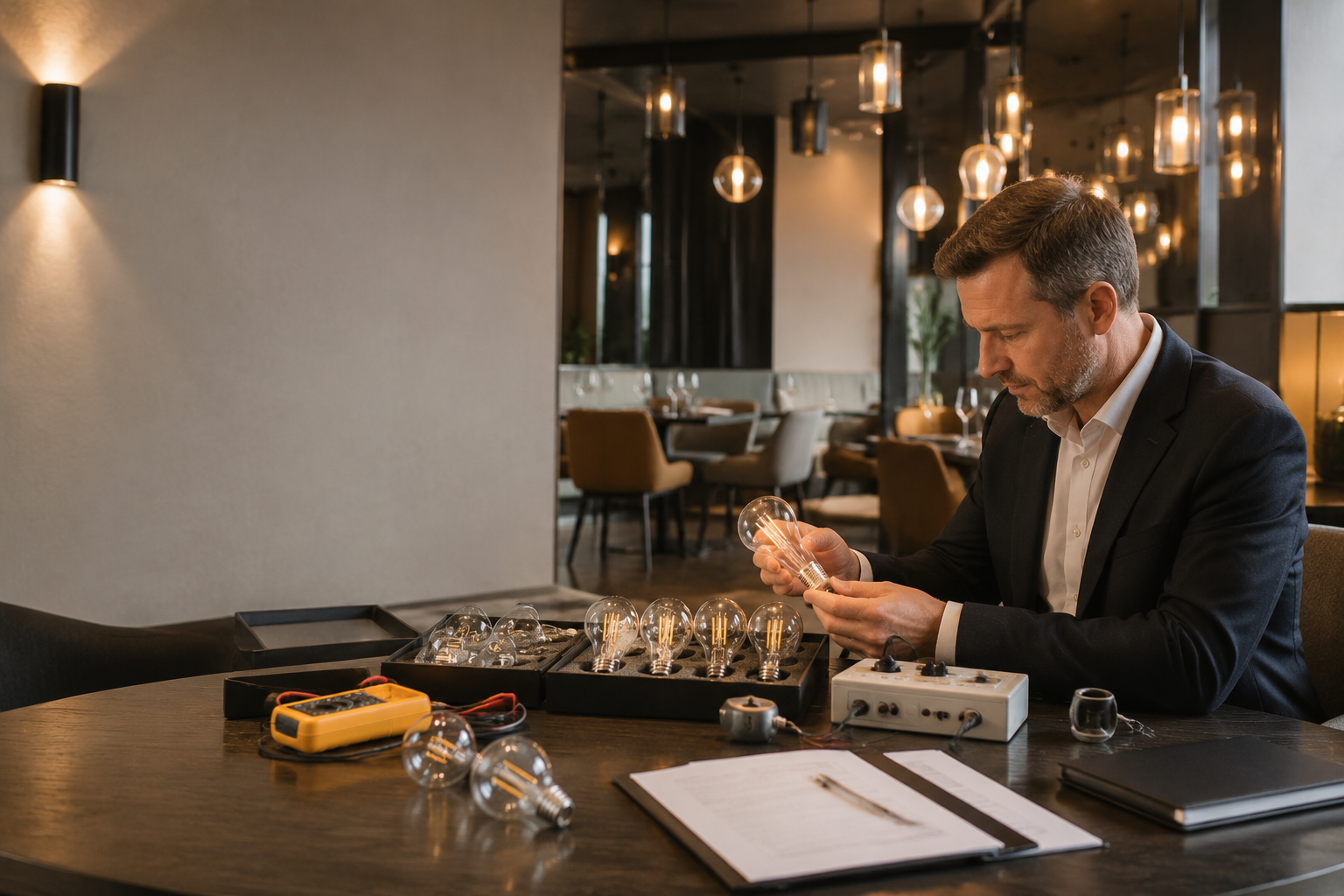
Quality control · warranty confidence
03Aging evidence shows what a quick power-on test can miss.
A bulb may light normally during an instant inspection and still reveal weaknesses once it operates continuously. An aging test gives the production team time to observe electrical stability, light-output consistency, driver behavior, filament condition, and connection quality before the batch is released.
That makes it useful evidence when you evaluate warranty suitability. It can help expose abnormal flicker, unstable brightness, intermittent operation, electrical failure, poor electrical connections, and other early failures that a brief test may not show.
Aging testing is a screening step for early reliability issues—not a promise of unlimited service life. Read it alongside the destination market, electrical environment, product configuration, and intended fixture.
A practical pre-shipment review
Instant power-on check
Confirm startup, basic illumination, and visible irregularities. This is the first screen, not the complete reliability review.
Continuous aging test
Run the assembled bulb continuously so flicker, brightness drift, intermittent operation, driver instability, and early electrical faults have a chance to appear.
Batch review
Compare observations across the production batch. Look for repeatable behavior rather than relying on one perfect sample.
Pre-shipment record
Keep the test observations with the order file so warranty discussions are connected to the approved product and quality-control process.
Ask what was monitored, under which electrical conditions, and how the findings relate to the fixture and operating environment where the bulbs will be used.
Before placing a wholesale order, request aging-test evidence and align the review with the final warranty period confirmed for your order requirements and destination market.
Discuss your order context04Thermal management is part of the warranty conversation.
A filament bulb does not manage heat through one isolated feature. In applicable designs, inert gas inside the glass envelope can help transfer heat away from the filament area toward the glass. The envelope then releases that heat outward. This supports more controlled operation, but it does not make the bulb immune to heat or guarantee unlimited lifetime.
For a wholesale order, the useful question is whether the complete system has been considered: filament structure, internal gas where applicable, glass envelope, driver behavior, fixture enclosure, ambient conditions, and continuous operating pattern.
Filament area
Heat begins at the working filament. If it remains concentrated, the internal operating temperature becomes harder to control.
Internal gas, where applicable
An inert gas fill can participate in heat transfer, helping move thermal energy toward the bulb wall rather than leaving it concentrated around the filament.
Glass envelope and room
The glass surface carries heat outward. Fixture geometry and airflow still determine how readily that heat can leave the lamp.
localized heat begins here
heat transfer where applicable
heat moves outward
environment completes the system
Inert gas is one part of the thermal system—not a substitute for driver stability, suitable fixture conditions, or quality evidence.
Turn the thermal mechanism into warranty questions
Heat accumulation can vary significantly with enclosure geometry and ventilation. Match the warranty discussion to the intended installation.
Destination-market conditions and the selected product configuration can affect the appropriate warranty arrangement.
Ask whether the review observed flicker, brightness stability, intermittent operation, driver behavior, filament condition, and early electrical failures—not only instant start-up.
Confirm the final warranty period, evidence requirements, replacement or after-sales process, and exclusions in writing for the actual order.
05Buyer Questions
These answers help wholesale buyers connect LED filament bulb warranty terms with product, market, testing, and installation risk.
What should a buyer evaluate before accepting an LED filament bulb warranty?
A wholesale LED filament bulb warranty should be matched to the actual order context, not judged as an isolated year count. Confirm the destination country, local voltage stability, order quantity, exact bulb configuration, installation environment, operating schedule, and commercial terms. A 1–3 year range is commonly discussed in B2B orders, but the final period must be agreed in writing for the specific order.
What details should an LED filament bulb warranty clause contain?
The warranty clause should state the covered product version, effective period, definition of a defect, required claim evidence, notification route, exclusions, and the remedy available to the buyer. It should also identify replacement or credit responsibility and any shipping treatment. Keep the approved sample, specification, batch reference, and final after-sales arrangement attached to the quotation or purchase agreement.
How does aging-test evidence support warranty evaluation?
Aging-test evidence helps show whether bulbs remain electrically and visually stable during continuous operation before shipment. It can reveal abnormal flicker, unstable brightness, intermittent operation, driver instability, electrical failure, poor connections, and other early problems that a brief power-on check may miss. Aging is a quality-control screening step, however, and does not guarantee unlimited service life.
Why must fixture conditions and local electrical conditions be recorded?
The intended fixture and electrical environment should be included in the warranty review because heat and voltage conditions can change operating stress. Check whether the bulb will run in an open, semi-enclosed, or enclosed fixture, along with expected operating hours, ambient conditions, ventilation, and local voltage stability. In applicable designs, inert gas helps transfer heat toward the glass envelope, but the complete fixture environment still matters.
Wholesale approval workflow
06Approve the warranty only when the order file is complete.
A warranty is easiest to manage when its scope is agreed before production, not interpreted after a field complaint. Use this final review to connect the proposed terms with the exact bulb version, destination market, electrical environment, and evidence your team will retain.
Confirm before approval
- Written warranty scope
Define what counts as a defective bulb, the applicable exclusions, and whether the remedy is replacement, credit, or another agreed response.
- Destination conditions
Review the purchasing country, local voltage stability, installation environment, and any market-specific operating requirements.
- Exact product version
Match the warranty discussion to the approved bulb construction, driver behavior, visual-comfort choice, and intended fixture.
- Quality evidence
Ask how aging-test observations, pre-shipment inspection, and early-failure screening will be linked to the released batch.
Record in the order file
- Quantity and order reference
Record the confirmed order quantity, production batch reference, approved sample, and any revision or packaging details.
- Agreed warranty term
A 1–3 year range is a conditional reference commonly arranged in B2B orders; the final period must follow the order requirements and destination market.
- Claim evidence process
State the photos, samples, operating details, batch data, and response timing needed to review a reported failure.
- Commercial agreement
Keep the final after-sales arrangement, replacement responsibility, shipping treatment, and approved product specification together with the purchase order.
Approval principle: aging tests can help identify unstable units before shipment, but they do not create an unlimited-life promise. Warranty suitability still depends on the complete order context.
Need order-specific warranty confirmation?
Send the destination country, bulb specification, expected quantity, fixture conditions, and quality evidence request. We can discuss the appropriate warranty arrangement and sample or aging-test review before approval.
The final warranty period and commercial remedy are confirmed against the actual order, product configuration, destination, and agreed terms.



Looking for a Product, Not Just Information?
Explore AromaLight LED filament bulb models or send us your specifications, reference photos and OEM / ODM requirements.