
How to Choose LED Filament Bulbs for Wholesale & B2B Markets
B2B BUYING GUIDE 01 / SOURCE BETTER BEFORE SOURCING Before You Source, Know What to Specify. Choosing LED filament bulbs for wholesale and B2B distribution involves more than selecting an attractive bulb shape. The product also needs to...
← BACK TO JOURNALBefore You Source, Know What to Specify.
Choosing LED filament bulbs for wholesale and B2B distribution involves more than selecting an attractive bulb shape.
The product also needs to match your target market, electrical requirements, fixture application, visual positioning, packaging strategy and purchasing plan.
This guide breaks the sourcing process into the key specifications buyers should review before requesting samples or moving toward production.
You do not need a complete technical specification to start. A reference photo, target market and estimated quantity can already provide a useful starting point.
01 Choose the Right Bulb Shape & Size
Bulb shape is not only a visual decision. It influences fixture compatibility, product positioning, packaging dimensions and how the lamp is presented in the final application.
Chandeliers, wall lamps and compact decorative fixtures.
Decorative fixtures, compact pendants and residential lighting.
General lighting, decorative fixtures and familiar retail bulb collections.
Restaurants, cafés, hotels and visible decorative lighting installations.
Pendant lamps, open fixtures and decorative statement lighting.
Large pendant fixtures, hospitality spaces and statement decorative applications.
Confirm the fixture opening, available installation space, carton requirements and target application before locking the final bulb dimensions.
02 Select the Correct Lamp Base
The lamp base must match the fixture, electrical specification and intended market. Confirm the base before finalizing samples, packaging or production.
Compact Decorative Applications
Suitable for smaller decorative bulb formats and fixtures designed around a compact screw base.
Decorative & General Lighting
Commonly paired with candle, globe and other compact LED filament bulb designs.
Medium Base Configuration
Used with many standard and decorative bulb formats where a medium screw base is specified.
Broad Product Compatibility
Frequently specified across standard, Edison-style and oversized decorative filament bulb families.
Confirm the exact lamp base together with the fixture, target market and electrical requirements. For example, E26 and E27 are visually similar medium screw bases, but the final product specification should follow the intended application and market requirement.
Which socket is used in the final lamp fixture?
Where will the finished product be sold or installed?
Which bulb shape and overall dimensions are required?
What voltage and wattage configuration is planned?
Now define the voltage, wattage and dimming requirements for the target market.
03 Define Voltage, Wattage & Dimming
Electrical specifications should be confirmed around the target market, intended application and fixture requirements before the product moves into sampling or production.
Voltage should be discussed together with the destination market, lamp base and intended fixture. Do not finalize the product from appearance alone.
The required wattage should reflect the intended brightness, bulb format, application and commercial positioning of the finished product.
If dimming is required, include it in the product specification before samples are prepared so the electrical configuration can be reviewed accordingly.
If the same bulb design will be sold in different markets, confirm whether the electrical configuration needs to be reviewed separately before placing the order.
Next, define the color temperature and glass finish that shape the visual character of the bulb.
04 Define the Light Color & Glass Finish
Color temperature and glass finish work together to shape how an LED filament bulb looks both when illuminated and when the lamp is switched off.
Color Temperature
Select the light appearance around the intended environment, fixture and product positioning.
Suitable where a very warm, ambient visual effect is desired.
Commonly considered for hospitality, residential and decorative applications.
A cleaner warm-light direction for broader decorative applications.
Consider where a less warm, more neutral appearance is preferred.
Glass Finish
The glass finish influences the appearance of the filament, the overall bulb character and how the product is positioned visually.
Keeps the internal filament structure highly visible and emphasizes the decorative construction of the bulb.
Creates a warmer visual identity and is often considered for vintage-style decorative product collections.
Gives the bulb a darker, more contemporary decorative appearance when the product is switched off.
Reduces direct visibility of the internal structure and creates a softer exterior visual effect.
Defines the light character.
Shapes the exterior appearance.
Creates the internal visual identity.
Consider for restaurants, cafés, hotels and atmosphere-led interiors.
A product family can use the same basic bulb format with different visual finishes.
Creates a darker visual identity for contemporary decorative collections.
LED filament bulbs are often visible inside open fixtures. The product therefore needs to look appropriate not only when illuminated, but also when the lamp is switched off.
Next, choose the filament arrangement that gives the bulb its internal design identity.
05 Choose the Filament Design Direction
In a clear or decorative glass bulb, the filament is part of the product’s visual identity. Its arrangement should be considered together with the bulb shape, glass finish and intended application.
When the bulb itself remains visible inside an open fixture, the internal filament arrangement becomes an important part of the finished lighting product rather than only a technical component.
A straightforward filament arrangement that works across many standard and decorative bulb formats.
Vertical filament structures can create a clean, balanced appearance inside clear decorative glass.
Spiral-style filament designs can give transparent or oversized bulbs a stronger decorative identity when the filament itself is intended to be seen.
For differentiated collections, the filament direction can be discussed together with glass shape, dimensions and other OEM / ODM requirements.
Defines the outer silhouette.
Controls filament visibility.
Creates the internal identity.
Will the bulb remain visible inside an open fixture?
Is the product positioned as functional or decorative?
Should the filament become a major part of the product design?
Does the collection need a differentiated custom appearance?
If an existing filament arrangement does not match the product direction, the next discussion should move into OEM / ODM development — combining the desired glass shape, filament concept, electrical specification and packaging requirements into one project.
Next, decide whether the project should use an existing product or move into OEM / ODM development.
06 Standard Product or OEM / ODM?
Not every B2B project needs a completely new bulb. The right sourcing route depends on how closely an existing product already matches your specification, branding and market requirements.
Start With a Standard Product
Choose an existing bulb when the shape, lamp base and general specification already fit the target project.
Existing bulb shape matches the requirement.
Standard lamp base is suitable.
Required electrical configuration can use an existing specification.
No distinctive structural development is required.
Move Into OEM / ODM
Consider custom development when the product needs to differ from existing standard configurations in a meaningful way.
Custom glass shape or dimensions.
Different filament arrangement or decorative concept.
Specific electrical or market configuration.
Private-label packaging, branding or product presentation.
Shape, proportions and product format.
Arrangement and visual direction.
Voltage, wattage and functional requirements.
Base specification for the intended fixture.
Clear, amber, smoke or other visual direction.
Branding, labels and retail presentation.
You Do Not Need a Finished Specification.
A custom development discussion can begin with incomplete information. A reference product, drawing, target market or even a product idea can provide a useful starting point.
A successful B2B product does not need to be completely different in every detail. In many cases, combining an established product platform with selected customization can provide a clearer and more efficient development path.
Next, plan the packaging and branding requirements before the project reaches bulk production.
07 Prepare the Project for Quotation
Once the main product direction is clear, bring the technical specification, packaging requirements and purchasing information together into one sourcing brief.
Shape, dimensions and general product style.
PRODUCTE12, E14, E26, E27 or the required fixture base.
FITTarget voltage, wattage and dimming requirements.
ELECTRICALColor temperature, glass finish and filament design.
APPEARANCEProduct box, labels, barcode and private-label direction.
PACKAGINGCountry, region or intended distribution market.
MARKETEstimated purchasing or project volume.
VOLUMEProduct photo, sample, drawing or product idea.
REFERENCEFor a new sourcing project, samples provide an opportunity to review the bulb dimensions, glass appearance, filament structure, color temperature, lamp base, electrical specification and packaging direction before moving toward a larger order.
A good LED filament bulb sourcing decision is not based on appearance alone.
The right product brings together the bulb shape, lamp base, electrical specification, visual design, target application, packaging and market requirements into one clear specification.
Have a Bulb, Drawing or Idea?
Send your available product information to AromaLight. A complete specification is not required to begin the discussion — a reference image, target market and estimated quantity can provide a starting point.
Continue Reading The Journal.

LED Filament Bulb Troubleshooting: Diagnose Flicker and No-Start Samples
READ STORY →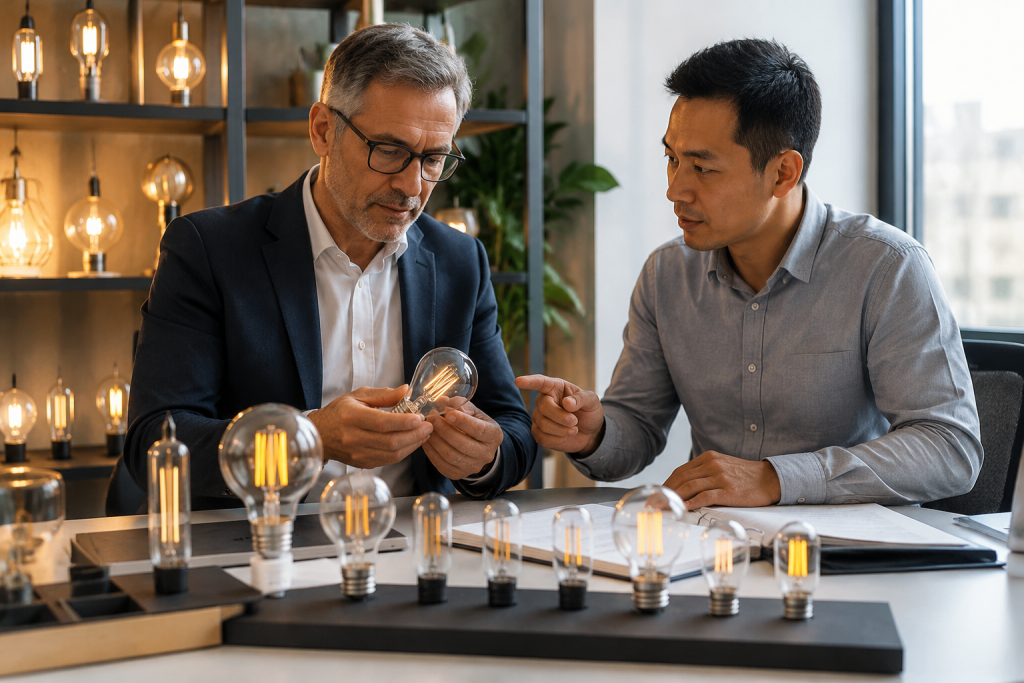
How to Evaluate LED Filament Bulb Warranty Terms Before a Wholesale Order
READ STORY →
How to Select LED Filament Bulb Driver Options for OEM Performance
READ STORY →Looking for a Product, Not Just Information?
Explore AromaLight LED filament bulb models or send us your specifications, reference photos and OEM / ODM requirements.